
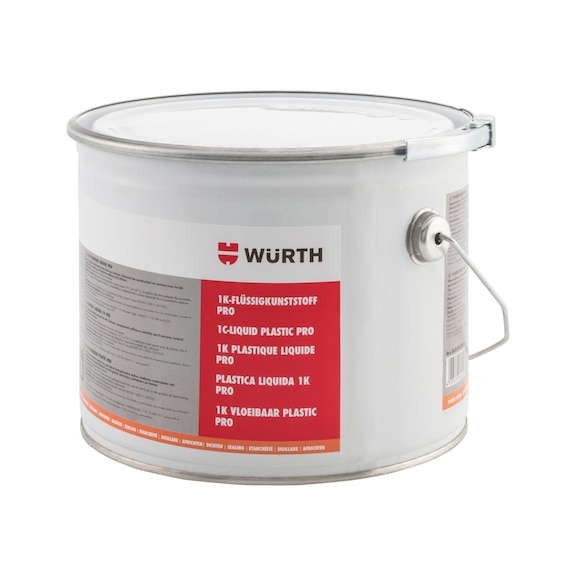

1C liquid plastic Pro
LIQUPLA-1C-PRO-RAL7035-7KG
Art.-no. 0838892551
EAN 4053479162393

Register now and access more than 125,000 products
- Universal, low-odour product
- Easy to use, long working time
- EMICODE seal, can be applied directly from the container in small quantities, different test certificates for different applications
- Solvent and isocyanate free
- Low emissions and easy to use
- Thixotropic (the fluid becomes thinner as it is deformed/mixed)
- Highly elastic
- UV resistant
- Alkali resistant
- Resistant to hydrolysis
- Rainproof after approx. 60 min
- Low Sd value (approx. 2 m)
- Can be removed in small quantities without needing to dispose of the remaining material in the container
- High storage stability
- Fire protection
BROOF (t1); BROOF (t2); BROOF (t3);BROOF (t4) in accordance with DIN EN 13501-5
Class E in accordance with DIN EN 13501-1
This product is classified in accordance with EMICODE® (EC1 Plus). EMICODE® is an independent labelling system for low-emission products, based on specified test methods and limit values.
- ETAG 005: ETA-19/0108. Guideline for the European Technical Approval for liquid applied roof waterproofing kits
- General test certificates from construction authorities for waterproofing buildings indoors and outdoors as well as for use on surfaces inclined up to 90°.
- DIN 18531 Waterproofing of roofs and balconies
- DIN 18532 Waterproofing of concrete areas trafficable by vehicles
- DIN 18533 Waterproofing of elements in contact with soil
- DIN 18535 Waterproofing of tanks and pools
- GISCODE classification: RSP20
| Base material | Pre-treatment | Primer |
| Aluminium | Clean the surface with acetone cleaner, roughen the surface | Rust Stop Quattro |
| Paints* | Grinding, remove completely | Dependent on substrate |
| Asphalt | Grinding, milling | Bitumen primer |
| Concrete | Grinding, milling | not required |
| Stainless steel | Cleaning of the surface with acetone cleaner; roughening of the surface | Rust-Stop Quattro |
| Anodised aluminium** | Cleaning of the surface with acetone cleaner; roughening of the surface | Rust-Stop Quattro |
| Screeds | Grinding, milling | not required |
| Glass* | Cleaning of the surface with acetone cleaner; roughening of the surface | not required |
| Hot bitumen paint* | not required | Bitumen primer |
| Wood | Remove paint | not required |
| Cold bitumen paint* | not required | Bitumen primer |
| Plastic sheeting (EPDM)* | Cleaning of the surface with acetone cleaner | Bitumen primer |
| Plastic sheeting (EVA) | Cleaning of the surface with acetone cleaner | Hard PVC primer |
| Plastic sheeting (PIB)* | Cleaning of the surface with acetone cleaner; roughening of the surface | Bitumen primer |
| Plastic sheeting (PVC-P, NB) | Cleaning of the surface with acetone cleaner; roughening of the surface | Soft PVC primer |
| Plastic sheeting (TPO, FPO) | Clean the surface with acetone cleaner; roughen the surface | Special primer |
| Lightweight concrete | Clean the surface with acetone cleaner; roughen the surface | not required |
| Powder-coated metals* | Dry cleaning of the surface; roughening of the surface | Rust-Stop Quattro |
| Plaster/masonry | remove paint if necessary | not required |
| Mortar, plastic-modified | Grinding, milling | not required |
| Polymer bitumen membranes (PYE-E) mod. (SBS) | not required | Bitumen primer |
| Polymer bitumen membranes (PYP) mod. (APP)* | not required | Bitumen primer |
| PVC moulded parts, hard | Cleaning of the surface with acetone cleaner | Hard PVC primer |
| Steel, zinc-plated | Cleaning of the surface with acetone cleaner; roughening of the surface | Rust-Stop Quattro |
| Composite thermal insulation systems* | not required | not required |
| Other base materials on request *Perform adhesion and compatibility tests **Alternatively without roughening after adhesion test with CONNECTION primer | ||
| Air temperature | Dew point temperatures in °C at a relative humidity of | ||||||||||
| °C | 45 % | 50 % | 55 % | 60 % | 65 % | 70 % | 75 % | 80 % | 85 % | 90 % | 95 % |
| 2°C | -7.77 | -6.56 | -5.43 | -4.40 | -3.16 | -2.48 | -1.77 | -0.98 | -0.26 | 0,47 | 1,20 |
| 4°C | -6.11 | -4.88 | -3.69 | -2.61 | -1.79 | -0.88 | -0.09 | 0,78 | 1,62 | 2,44 | 3,20 |
| 6°C | -4.49 | -3.07 | -2.10 | -1.05 | -0.08 | 0,85 | 1,86 | 2,72 | 3,62 | 4,48 | 5,38 |
| 8°C | -2.69 | -1.61 | -0.44 | 0,67 | 1,80 | 2,83 | 3,82 | 4,77 | 5,66 | 6,48 | 7,32 |
| 10°C | -1.26 | 0,02 | 1,31 | 2,53 | 3,74 | 4,79 | 5,82 | 6,79 | 7,65 | 8,45 | 9,31 |
| 12°C | 0,35 | 1,84 | 3,19 | 4,46 | 5,63 | 6,74 | 7,75 | 8,69 | 9,60 | 10,48 | 11,33 |
| 14°C | 2,20 | 3,76 | 5,10 | 6,40 | 7,58 | 8,67 | 9,70 | 10,71 | 11,64 | 12,55 | 13,36 |
| 15°C | 3,12 | 4,65 | 6,07 | 7,36 | 8,52 | 9,63 | 10,70 | 11,69 | 12,62 | 13,52 | 14,42 |
| 16°C | 4,07 | 5,59 | 6,98 | 8,29 | 9,47 | 10,61 | 11,68 | 12,66 | 13,63 | 14,58 | 15,54 |
| 17°C | 5,00 | 6,48 | 7,92 | 9,18 | 10,39 | 11,48 | 12,54 | 13,57 | 14,50 | 15,36 | 16,19 |
| 18°C | 5,90 | 7,43 | 8,83 | 10,12 | 11,33 | 12,44 | 13,48 | 14,56 | 15,41 | 16,31 | 17,25 |
| 19°C | 6,80 | 8,33 | 9,75 | 11,09 | 12,26 | 13,37 | 14,49 | 15,47 | 16,40 | 17,37 | 18,22 |
| 20°C | 7,73 | 9,30 | 10,72 | 12,00 | 13,22 | 14,40 | 15,48 | 16,46 | 17,44 | 18,36 | 19,18 |
| 21°C | 8,60 | 10,22 | 11,59 | 12,92 | 14,21 | 15,36 | 16,40 | 17,44 | 18,41 | 19,27 | 20,19 |
| 22°C | 9,54 | 11,16 | 12,52 | 13,89 | 15,19 | 16,27 | 17,41 | 18,42 | 19,39 | 20,28 | 21,22 |
| 23°C | 10,44 | 12,02 | 13,47 | 14,87 | 16,04 | 17,29 | 18,37 | 19,37 | 20,37 | 21,34 | 22,23 |
| 24°C | 11,34 | 12,93 | 14,44 | 15,73 | 17,06 | 18,21 | 19,22 | 20,33 | 21,37 | 22,32 | 23,18 |
| 25°C | 12,20 | 13,83 | 15,37 | 16,69 | 17,99 | 19,11 | 20,24 | 21,35 | 22,27 | 23,30 | 24,22 |
| 26°C | 13,15 | 14,84 | 16,26 | 17,67 | 18,90 | 20,09 | 21,29 | 22,32 | 23,32 | 24,31 | 25,16 |
| 27°C | 14,08 | 15,68 | 17,24 | 18,57 | 19,83 | 21,11 | 22,23 | 23,31 | 24,32 | 25,22 | 26,10 |
| 28°C | 14,96 | 16,61 | 18,14 | 19,38 | 20,86 | 22,07 | 23,18 | 24,28 | 25,25 | 26,20 | 27,18 |
| 29°C | 15,85 | 17,58 | 19,04 | 20,48 | 21,83 | 22,97 | 24,20 | 25,23 | 26,21 | 27,26 | 28,18 |
| 30°C | 16,79 | 18,44 | 19,96 | 21,44 | 23,71 | 23,94 | 25,11 | 26,10 | 27,21 | 28,19 | 29,09 |
| 32°C | 18,62 | 20,28 | 21,90 | 23,26 | 24,65 | 25,79 | 27,08 | 28,24 | 29,23 | 30,16 | 31,17 |
| 34°C | 20,42 | 22,19 | 23,77 | 25,19 | 26,54 | 27,85 | 28,94 | 30,09 | 31,19 | 32,13 | 33,11 |
| 36°C | 22,23 | 24,08 | 25,50 | 27,00 | 28,41 | 29,65 | 30,88 | 31,97 | 33,05 | 34,23 | 35,06 |
| 38°C | 23,97 | 25,74 | 27,44 | 28,87 | 30,31 | 31,62 | 32,78 | 33,96 | 35,01 | 36,05 | 37,03 |
| 40°C | 25,79 | 27,66 | 29,22 | 30,81 | 32,16 | 33,48 | 34,69 | 35,86 | 36,98 | 38,05 | 39,11 |
| 45°C | 30,29 | 32,17 | 33,86 | 35,38 | 36,85 | 38,24 | 39,54 | 40,74 | 41,87 | 42,97 | 44,03 |
| 50°C | 34,76 | 36,63 | 38,46 | 40,09 | 41,58 | 42,99 | 44,33 | 45,55 | 46,75 | 47,90 | 48,98 |
| The dew point table indicates at which surface temperatures condensation occurs. This is determined by the air temperature and relative humidity. Example: At an air temperature of 20°C and 55 % relative humidity, the dew point is at an object temperature of +10.7°C. The surface temperature should be 3°C above the dew point during application. | |||||||||||
- ETAG 005: ETA-19/0108. Guideline for the European Technical Approval for liquid applied roof waterproofing kits
- General test certificates from construction authorities for waterproofing buildings indoors and outdoors as well as for use on surfaces inclined up to 90°.
- DIN 18531 Waterproofing of roofs and balconies
- DIN 18532 Waterproofing of concrete areas trafficable by vehicles
- DIN 18533 Waterproofing of elements in contact with soil
- DIN 18535 Waterproofing of tanks and pools
- GISCODE classification: RSP20
The usage instructions are recommendations based on the tests we have conducted and our experience; carry out your own tests before each application. Due to the large number of applications and storage and processing conditions, we do not assume any liability for a specific application result. Insofar as our free customer service provides technical information or acts as an advisory service, no responsibility is assumed by this service except where the advice or information given falls within the scope of our specified, contractually agreed service or the advisor was acting deliberately. We guarantee consistent quality of our products. We reserve the right to make technical changes and further develop products.
The DIN standards, regulations, technical regulations and recognised codes of practice applicable to the relevant trades must be observed, e.g. DIN 18195, DIN 18531, the technical regulations for metalwork in the roofing trade and the technical regulations for seals—the flat roof directive—issued by the ZVDH (German central association for the roofing trade). Würth accepts no liability relating to any application or implementation which is not specified by a standard, a technical regulation or the Würth work instructions, or which does not correspond to the recognised codes of practice.
Datasheets(X)

For waterproofing used/unused roofing, balconies, components in contact with the ground, tanks and windows as well as for sealing foundations and bases in areas where they are in contact with the ground, wells and under foreign surfaces. In combination with a 110g/m² fleece inlay, a standard-compliant seal is created.
25 kg containers with lower viscosity for easier application on large surfaces.
Stir the material thoroughly with a stirrer before use. Before application, certain minimum adhesive strengths (concrete: 1.5 N/mm) must be proven on pre-treated test surfaces.
The substrate must be clean and dry (max. residual moisture 6 % by weight) and free from grease and oil. During the coating work, the mineral substrate must only be matt-damp; there must be no standing water. Protect against moisture penetration from the rear. Remove cement residues.
Pre-treatment depends on the substrate. Follow the information in the substrate table. The surface temperature must be between 5 °C and 35 °C. The surface temperature must be 3 °C above the dew point. Observe the dew point table below.
Mask the edges of the area to be waterproofed. Apply a generous amount of material using a roller or brush (1.5 kg/m2). Then insert the cut fleece or pre-formed fleece into the first layer, making sure to remove any air bubbles. Make sure that they are completely soaked. Then apply another layer of liquid plastic (1.5 kg/m2) while the previous layer is still fresh. Make sure that there are no air bubbles trapped inside the material. Ensure a minimum layer thickness of 2.1 mm. For upturned edges, the connection height above the covering must be 15 cm. Where the fleece overlaps, ensure that it overlaps by 10 cm when using other materials and by 5 cm when using Pro 1C liquid plastic. Apply sand in a layer of min. 7 kg/m² under other coverings. Grit 0.4 mm to 1.2 mm. Further information is available in the technical data sheet.
Chemical basis | Single component polyurethane |
Colour | Light grey RAL 7035 |
Density | 1.5 g/cm³ |
Fully hardening/curing conditions | 20°C |
Suitable for further processing up to | 24 h |
May be walked on after max. | 2 d |
Able to withstand rain after | 60 min |
Conditions for ability to withstand rain | at 20°C |
May be walked on in following conditions | at 20°C and 50% relative humidity |
Further processing conditions | without other measures |
Min. processing temperature | 5 °C |
Max. processing temperature | 35 °C |
Max. temperature resistance | 80 °C |
Building material class | E - Normally inflammable |
Solvent-free | Yes |
Styrol-free | Yes |
Ultraviolet resistance | Very good |
Bitumen-free | Yes |
Resistance against | Aging (very good), UV radiation (very good), Weather (very good) |
Crack bridging | 5 mm |
Crack bridging conditions | for 2-mm layer thickness |
Application quantity in weight/area | 3 kg/m² |
Container | Bucket |
Weight of content | 7 kg |
Shelf life from production | 12 Month |
Conditions to maintain shelf life from production | at 10°C to 30°C |
Select RAL-colour code
!! NOTE: On-screen visualisation of the colour differs from real colour shade!!
Last viewed

Universal puller set for 6 different twin leg and triple leg pullers

Rechargeable battery LI 3.6 volt/2.0 Ah

3/8" socket wrench insert Inch, hexagon, short

Cable bracket for overhead mounting

Linen adhesive tape

Access frame for step kit/step kit Plus

Mounting frame set 4 for workbenches

Connection adapter for Max hammer drill bits and core drill bits with a minimum diameter of 32 mm

EVAPO-Clean vehicle air conditioner cleaner

Multiplex cover panel For cabinet covers of system cabinets