


Floor joint sealant
JNTCOMPD-GREY-600ML


Register now and access more than 125,000 products
- Very low emission with tested emissions properties.
- Approved for use with foodstuffs (ISEGA certificate) - suitable for sealing in areas where food is processed or stored.
- Elastic for compensation of different material expansion rates as well as for vibration and sound damping.
- Prevents contact corrosion.
- Bubble-free curing system.
- Silicone-free.
This product is classified according to EMICODE® (EC1 Plus). EMICODE® is an independent low-emission labelling system based on established test and limit values.
Tested in accordance with EN 15651 Part 4
- Fire performance: Class E
- Tear resistance: Passed
- Volume loss: ≤ 10 %
- Tensile behaviour under pre-stress: Passed
- Adhesion/expansion after being immersed in water for 28 days: Passed
- Adhesion/expansion after being immersed in salt water for 28 days: Passed
- Tensile behaviour under pre-stress at -30 °C: Passed
- Durability: Passed
- Must not be used for glass sealing or in swimming pools.
- Curing time of 14 days at approx. 20 °C material and floor temperature up to full load capacity.
- Sufficient ventilation should be ensured during the curing phase.
- A higher coating thickness extends the curing time.
- The colour can be affected by environmental factors and external influences, such as chemicals, high temperature, UV radiation, unsuitable paints or smoothing agents. These potential changes in colour do not affect the technical and protective properties of the product.
- Elastic sealants must never be painted. Coats of paint have limited elasticity and can crack and flake when movement occurs in the joint.
- Colour changes due to intolerances cannot be excluded. For sealant-compatible coats of paint, the joint edges should be trimmed by a maximum of 1 mm (test in accordance with DIN 52 452-4).
- Do not use on bituminous or other surfaces that can bleed oil or plasticisers, e.g. EPDM or natural rubber, or carry out preliminary tests.
- Good chemical and mechanical resistance. It must be ensured that joints cannot be destroyed with hard cleaning brushes. Chemicals used may reduce resistance.
- All tools and processing accessories must be immediately cleaned with adhesive remover. Hardened sealant residues can only be removed mechanically.
- In its uncured state, must not be mixed or come into contact with substances that react with isocyanate. Otherwise the final reaction and linking of the material will be impaired or prevented. In particular alcohols that are a component of spirit, thinner, cleaning agent and formwork oil must be avoided.
Tested in accordance with EN 15651 Part 4
- Fire performance: Class E
- Tear resistance: Passed
- Volume loss: ≤ 10 %
- Tensile behaviour under pre-stress: Passed
- Adhesion/expansion after being immersed in water for 28 days: Passed
- Adhesion/expansion after being immersed in salt water for 28 days: Passed
- Tensile behaviour under pre-stress at -30 °C: Passed
- Durability: Passed
The usage instructions are recommendations based on the tests we have conducted and our experience; carry out your own tests before each application. Due to the large number of applications as well as the storage and usage conditions, we do not assume any liability for a specific application result. Any technical information or advice provided by our free customer service shall be provided to the exclusion of any liability, unless the advice or information is part of our contractually agreed scope of services or the advisor was acting wilfully. We ensure the consistent quality of our products. We reserve the right to make technical changes and further develop products.
Datasheets(X)

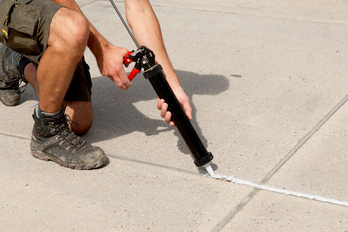
The floor joint sealant is particularly suitable for joining movement and connection joints indoors and outdoors in food-related areas. Suitable for floor joints in concrete and screed exposed to static loads or rolling traffic, e.g. joints in warehouses, production halls, parking decks, yard areas, underground garages, for tiled floors in entrance halls and stairwells.
- The joint edges must be load-bearing, stable, clean, dry and free from oil, grease and loose components, concrete slurry, paint, hydrophobing agents and anti-graffiti coatings.
- After preparing the substrate and inserting a tightly fitting closed-cell PE round cord, use a suitable gun to insert the joint sealant into the prepared joint. Make sure that the sealant is inserted without any air bubbles or cavities and is in full contact with joint edges. Finally, use a suitable smoothing tool or joint knife to smooth the joint surface. When doing so, press the sealant onto the adhesive surfaces and the backer rod.
- If necessary, the surface can be smoothed with Würth sealant smoothing agent.
- Please refer to the application instructions in our sealant guidelines.
- For more information, please refer to the technical data sheet.
Colour | Grey |
Contents | 600 ml |
Chemical basis | Single component polyurethane |
Density | 1.35 kg/l |
Continuous motion absorption | 20 % |
Min. temperature resistance | -40 °C |
Max. temperature resistance | 80 °C |
Min. surface processing temperature | 5 °C |
Max. surface processing temperature | 40 °C |
Min. processing temperature | 5 °C |
Max. processing temperature | 40 °C |
Min. skin-formation time | 65 min |
Conditions for skin-formation time | at 23°C and 50% relative humidity |
Shelf life from production/conditions | 12 Month / cool and dry storage area, no exposure to sunlight, 15°C to 25°C, in tightly closed original container |
Solvent-free | Yes |
Silicone-free | Yes |
Recoatable/Can be painted over | Yes |
Smell/fragrance | Odourless |
Ultraviolet resistance | UV-stabilised |
Breaking elongation | 700 % |
Select RAL-colour code
!! NOTE: On-screen visualisation of the colour differs from real colour shade!!
Last viewed

Plug-in screw connection with clamping ring

Oval rosette aluminium, outer PZ
Protective glove, leather Nitras 1409 Driver

Handle plate on outer plate

Disposable nitrile glove

Soft lead-free electronic solder no. 1 RoHS-compliant

Pin contact Micro Quadlok System (MQS) 0.63 uninsulated

Hexagon nut ISO 4032, silver zinc-nickel plated 10 steel (ZNSHR)

Tongue for hygienic design sash lock Plain A2 stainless steel 1.4301

High-pressure hose HDR 160 C/185 PP