
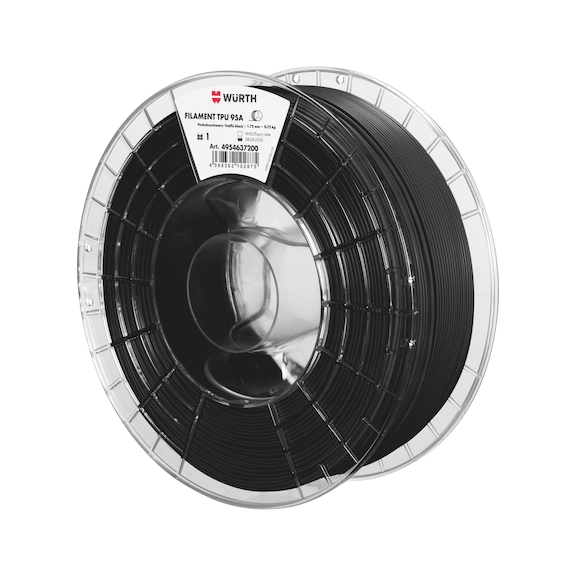


TPU 95A filament
PRNTMATL-TPU-95A-TRAFFICB-D1.75MM-0.75KG
Register now and access more than 125,000 products
- Rubber-like elastic elastomer (soft technical plastic)
- UV-resistant
- Good chemical resistance to e.g. oils and greases
- High elongation at break
- High abrasion resistance
- Very impact- and break-resistant
- Halogen-free
- Shore hardness 95A
- TPU filament with 95A Shore hardness offers an ideal compromise between durability and flexibility, easy to handle and perfect for getting started in flexible 3D printing with a direct drive or Bowden-style printer
- Optimised material with good layer adhesion
- Free from silicone, plasticisers and oils
- Can be printed on direct drive and Bowden-style printers
- Raw material is certified in accordance with REACH and RoHS standards
The information in the data provided is based on our current knowledge and experience. Due to the many possible influences during processing and application of our products, this information does not release the user from the obligation to perform their own inspections and tests, and it does not contain any guarantee of properties or suitability of the product for a particular purpose. It is the responsibility of the user to determine the process capability of their 3D printer and to conduct tests for their use cases using our materials. The values refer to test specimens generated from the semi-finished product and not to values based on printed test specimens.
Datasheets(X)

TPU 95A filament (thermoplastic polyurethane with Shore hardness 95A) is a popular elastomer material in FDM/FFF 3D printing, used in particular when printed components need to be flexible yet able to withstand everyday use. Compared to PLA, TPU 95A remains elastic and impact resistant, making it ideal for parts that need to absorb bending, pressure and impact forces without breaking. TPU 95A is noticeably harder and more dimensionally stable than TPU85A, yet remains highly elastic. It is typically used for mechanically resistant, functional parts for everyday use, such as O-rings/seals, spacers, robust housing and parts for sports equipment. The key difference is in the hardness range (Shore A vs. Shore D): Shore A describes softer, rubber-like elastomers (e.g. 85A/95A), whereas Shore D is used for significantly harder, more rigid materials (e.g. 65D).
Additional printing guidelines
- High extruder speeds can affect printing accuracy.
- It is recommended to select the speed based on your own experience and approach the upper limit from there.
 | |
Manufacturers | Würth |
Material | TPU 95A - Thermoplastic polyurethanes |
Filament diameter (dF) | 1.75 mm |
Weight of filament | 0.75 kg |
Empty weight of filament spool | 260 g |
Colour | Traffic black, similar to RAL 9017 |
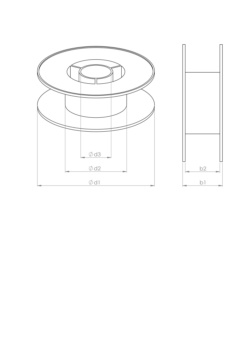
Diameter (d1) | 200 mm |
Diameter 2 (d2) | 105 mm |
Diameter 3 (d3) | 52 mm |
External width (b1) | 68 mm |
Internal width (b2) | 59 mm |
Nozzle temperature temperature min./max. | 230-250 °C |
Min./max. temperature printing bed | 40 to 70 °C |
Min./max. fan speed | 20-70 % |
Printing speed min./max. | 15-80 mm/s |
Max. volumetric speed | 3 mm³/s |
Adhesive recommended | Not required |
Closed installation space | Not required |
Hardened nozzle | Not required |
Shelf life from production/conditions | 24 Month / in intact original packaging, no direct sunlight, dry and clean storage area at 18°C bis 27°C/65°F bis 80°F room temperature |
Last viewed

Protective film set SR 580 Sundström T06-0801

Wire end ferrule with plastic sleeve strips

Hammer holder

Cable grip with loop and swivel

Long plate pair ZD oval Without handle hole

Hexagon Socket Head Cap Screw with centre, with low head DIN 6912, blue passivated zinc plated 10.9 steel (A2K)

Prusa brass printer nozzle

System assembly trolley 8.8

MFD LONGLIFE & SPEED twist drill bit HSCo DIN 338

Crimping jaws for crimping tool B12